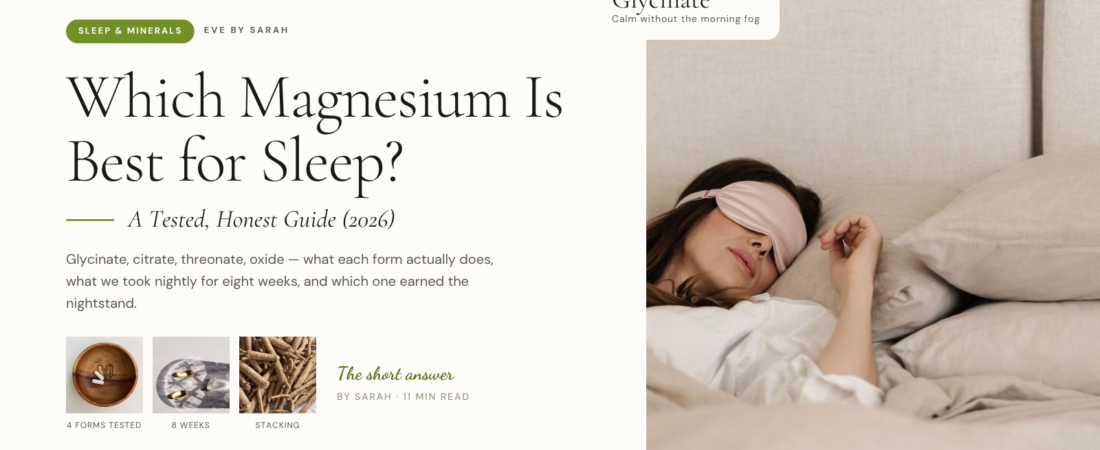
The short answer: magnesium glycinate is the best form of magnesium for sleep for most women. It pairs magnesium with the calming amino acid glycine, it’s gentle on the stomach, and it’s the form most associated with relaxation and easier, deeper rest — without the laxative effect of cheaper types like magnesium oxide.
If you’ve stood in the supplement aisle (or scrolled Amazon at 11pm) staring at glycinate, citrate, oxide, threonate and “complex” blends, this guide settles it. Below is the plain-English comparison, how much to take, when to take it, and what to reach for when magnesium alone isn’t quite enough. Everything here is framed to support restful sleep — magnesium isn’t a sedative and it won’t knock you out. It quietly makes winding down easier, which for a lot of us is the whole problem.
By Sarah, founder of Eve by Sarah · Updated September 11, 2026
Which magnesium is best for sleep?
Magnesium glycinate is the form most associated with sleep and relaxation — it’s gentle on the stomach and calming, which is exactly what you want at night. Magnesium oxide, the cheap kind you’ll find in most drugstore bottles, is poorly absorbed and mostly works as a laxative, so it’s the wrong pick for bedtime.
Here’s the simple way to think about it: the mineral is the same, but what it’s bound to changes how well you absorb it and how it feels. Glycine — the amino acid attached to glycinate — is calming in its own right, which is why this form has become the on-brand favourite for anyone trying to sleep. It’s the one I keep on my nightstand: a clean magnesium glycinate is where I’d tell almost anyone to start.
Magnesium glycinate vs citrate vs oxide vs threonate: what’s the difference?
For sleep, glycinate wins for most people; citrate is a reasonable budget alternative if you also tend toward constipation; oxide is best skipped for sleep; and threonate is the pricey “brain” form some people prefer. That’s the whole decision in one sentence — here’s the detail.
- Magnesium glycinate (bisglycinate) — the calm-sleep pick. High absorption, gentle on digestion, paired with calming glycine. Best all-rounder for winding down.
- Magnesium citrate — well absorbed and inexpensive, but it draws water into the gut, so it can loosen things. Fine at a modest dose if your stomach tolerates it; a standard magnesium supplement like this is an easy entry point.
- Magnesium oxide — cheap and everywhere, but less than a quarter is absorbed. Mostly useful as a laxative, not a sleep aid.
- Magnesium L-threonate — marketed for focus and memory because it crosses into the brain more readily. Interesting, but more expensive and not necessary for most people who just want to sleep.
If you remember one thing: glycinate for calm, citrate on a budget, skip oxide for sleep.
Does magnesium really help you sleep?
Magnesium supports the calming pathways involved in sleep, and many women simply don’t get enough of it from food. It won’t knock you out — it quietly makes winding down easier. Think of it as lowering the volume on a busy nervous system rather than flipping an off-switch.
Magnesium is involved in hundreds of reactions in the body, including the ones that help regulate the “rest and digest” side of your nervous system and support healthy melatonin signalling. Dietary surveys consistently find a large share of adults fall short of the recommended intake (around 310–320 mg a day for adult women, per the U.S. National Institutes of Health). If you’re low, topping up can gently support better rest — which is different from a promise to fix insomnia, a medical issue you should take to your doctor.
How much magnesium glycinate should I take for sleep?
A common supportive range is about 200–400 mg of elemental magnesium in the evening, and it’s sensible to start at the lower end. More is not better — go slowly and see how you feel before increasing.
Two practical notes. First, read the label carefully: the big number on the front (say, 1,000 mg) is often the weight of the whole compound, while the elemental magnesium you actually absorb is smaller — that’s the number that matters. Second, magnesium can interact with some medications and isn’t right for everyone, so if you’re pregnant, breastfeeding, on medication, or managing a health condition, check with your doctor first. Not medical advice.
When should I take magnesium for sleep?
Take it about 30 to 60 minutes before bed, ideally at the same time each night so it becomes part of your wind-down cue. Consistency matters more than perfect timing.
Magnesium works best as one small step in an evening routine, not a rescue pill you swallow the moment you can’t sleep. Pairing it with the same few signals every night — dimmer lights, last screen away, a warm shower — trains your body to expect sleep. I take mine at 9pm alongside a spritz of deep-sleep pillow spray; over time the smell alone tells my brain the day is over.
What helps you sleep without melatonin?
Magnesium glycinate, glycine, L-theanine, and a consistent wind-down routine help many people sleep without melatonin — which is a hormone, not a sedative, and is best used short-term. This is Eve’s whole position: reach for the gentle, sustainable supports before the hormone.
Melatonin signals “it’s night” to your body; it doesn’t sedate you, and taking it every night long-term isn’t the reset most people hope for. If melatonin has stopped working for you, the issue is usually routine and light exposure, not the dose. Magnesium glycinate and a fixed bedtime are gentler places to put your effort. If you want to go deeper on the two supplements women ask about most, Sarah compared them in detail in this Eve essay: Ashwagandha vs Magnesium Glycinate.
What can I add when magnesium alone isn’t enough? (my sleep-support kit)
If your body still won’t “switch off,” the next levers are a calmer environment and a calmer nervous system — the room and the routine do more than any single supplement. Supplements are the last 5%; your sleep setup is the other 95%. Here’s the simple kit I actually reach for:
- A weighted blanket — the deep, even pressure reads as safety for a racing mind, the same reason a hug is calming. My top pick is the YnM Weighted Blanket (glass beads, 7-layer); choose roughly 10% of your body weight, and skip it if you have circulation or breathing concerns.
- A supportive ergonomic pillow — the wrong pillow height keeps your neck out of line and wakes you with tension. An ergonomic memory-foam pillow sized for how you sleep (side, back or combination) is a small change that often pays off fast.
- A cooling mattress topper — if you run warm, overheating is a quiet reason you wake in the night. A breathable cooling mattress topper helps you stay cool without freezing the whole room.
- A deep-sleep pillow spray — a few sprays of a pillow spray become a scent cue your brain learns to read as “time to sleep.”
- A sleep tracker — for the best tracking depth, the Oura Ring 4 is my top pick: accurate sleep staging and a rich overnight breakdown in a sleep-centric app. Use it as a gentle mirror to spot which habits actually improve your nights, not a perfect score to chase.
- An adaptogen, if stress is the culprit — if daytime stress spills into your evenings, a standardised ashwagandha (KSM-66) is the adaptogen most people try first to support a calmer baseline.
As always: gentle support, not a cure. This isn’t medical advice — if you have serious or ongoing sleep problems, please check with your doctor.
Why do I keep waking up at 3am — and can magnesium help?
A 3am wake-up is often a blood-sugar dip or evening cortisol that’s still too high — your stress hormone should be at its lowest overnight. Ending your day on purpose (dim light, no late caffeine, a magnesium wind-down) can help you stay asleep, not just fall asleep.
This is where sleep and stress overlap. If you’re “tired but wired” — exhausted yet unable to switch off — the fix is usually rhythm, not another pill: morning daylight to anchor your clock, protein before caffeine, and a real wind-down at night. Magnesium supports the calm side of that loop, which is why it shows up in both the sleep and the stress conversation.
The 5-minute magnesium sleep routine
You don’t need a 20-step ritual. Here’s the simple version worth actually doing every night:
- Dinner finished at least 2–3 hours before bed, so your blood sugar isn’t spiking while your body tries to wind down.
- Magnesium glycinate 30–60 minutes before sleep, same time each night.
- Lights dimmed, last screen away, room cool (around 18°C / 65°F) and dark.
- One calming cue — pillow spray, a few slow breaths with a longer exhale, or a boring book.
Get the free Deep-Sleep Checklist
Want this on one page you can stick by your bed? Download Eve’s free Deep-Sleep Checklist — the exact wind-down, simplified, plus the magnesium quick-reference. Get the free checklist here → (join the Eve email list and it lands in your inbox.)
#ad — This post contains affiliate links. If you buy through them, Eve may earn a small commission at no extra cost to you. We only link to products Sarah actually uses or would recommend.
Not medical advice · informational only. If you have serious or ongoing sleep problems (like insomnia or sleep apnea), please check with your doctor.
Frequently asked questions
Which magnesium is best for sleep?
Magnesium glycinate is the form most associated with sleep and relaxation — it’s gentle on the stomach and calming. Magnesium oxide, the cheap kind, is poorly absorbed and mostly a laxative.
Does magnesium really help you sleep?
Magnesium supports the calming pathways involved in sleep, and many women are low in it. It won’t knock you out — it quietly makes winding down easier.
What helps you sleep without melatonin?
Magnesium glycinate, glycine, L-theanine, and a consistent wind-down routine help many people sleep without melatonin — which is a hormone, not a sedative, and best used short-term.
How much magnesium glycinate should I take for sleep?
A common supportive range is about 200–400 mg of elemental magnesium in the evening. Start low, go slow, and check with your doctor if you’re pregnant, on medication, or managing a health condition.
Is melatonin bad to take every night?
Melatonin is a hormone that signals “night,” not a sleeping pill. It’s best for jet lag or short-term use — for ongoing sleep, light timing and a wind-down routine matter more.
What is the best natural sleep aid?
The best “aid” is a dark, cool, quiet room and a consistent bedtime. Beyond that, magnesium glycinate is the gentlest, most-studied supportive supplement.
Why can’t I stay asleep even when I’m tired?
“Tired but wired” usually means evening cortisol is too high — your body never got the signal the day was over. A real wind-down and morning light help reset the rhythm.
—–About the author
Sarah is the founder of Eve by Sarah, a wellness brand for ambitious women who struggle to switch off — focused on cortisol, sleep, anti-inflammatory eating and slow living. She writes from years of testing the calm-nervous-system approach on herself and sharing what actually helped. Eve’s guidance is gentle, plain, and never hypey. This article is informational only and not medical advice; if you have serious or ongoing sleep problems such as insomnia or sleep apnea, please speak to your doctor.